You’ve done the research, run the numbers, and decided that building an ADU — a backyard cottage, a garage conversion, or a detached in-law suite — makes total sense for your property. Then someone mentions four letters that stop a lot of homeowners cold: H-O-A.
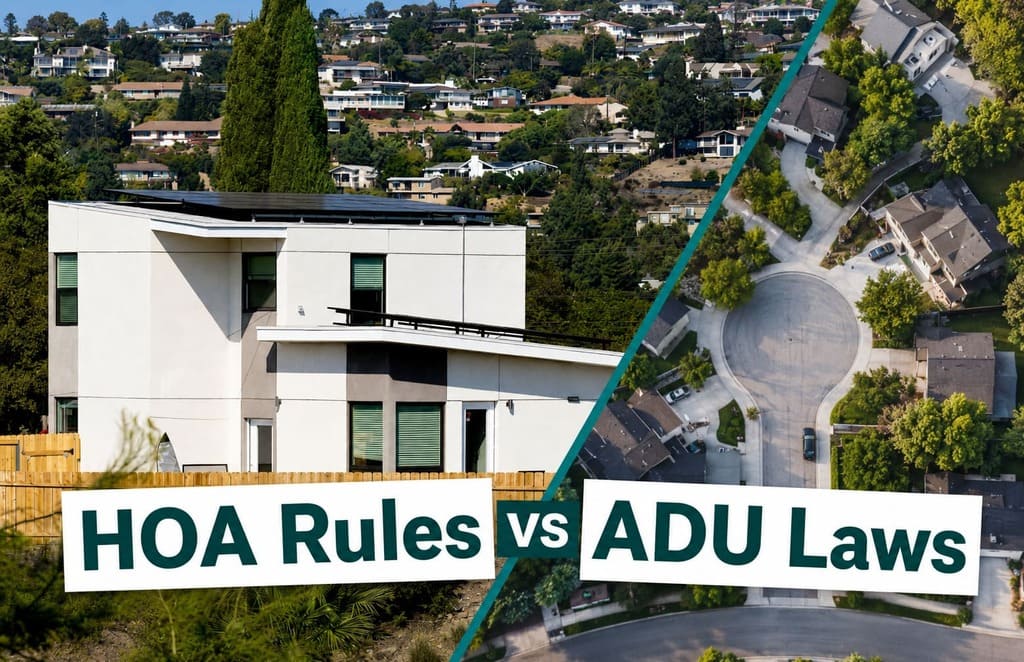
Can your Homeowners Association actually stop you from building an ADU? The honest answer isn’t a clean yes or no. It depends on where you live, what your governing documents say, and — most critically — what your state legislature has decided. And right now, the legal tide is shifting heavily in favor of homeowners.
Why HOAs and ADUs Are Colliding Right Now
The housing shortage across the United States has pushed state governments to act. ADU permitting in California alone jumped from roughly 6,000 in 2018 to nearly 16,000 in 2019 after the state began stripping away barriers — and it has only accelerated since. That same momentum is spreading to Washington, Arizona, Oregon, and beyond.
HOAs, however, were written in a different era. Many CC&Rs contain restrictions that were drafted decades before state ADU laws existed, creating a direct collision between private contractual rules and public housing policy. Knowing which one legally prevails — and when — is the most important thing you can understand before starting your project.
For a practical overview of ADU types and what’s possible on your lot, FindADUPros is an excellent place to start.

Understanding HOA ADU Restrictions: Where Do They Come From?
Before you can push back on your HOA, you need to understand where its authority actually comes from — and what its real limits are.
What Are CC&Rs and Why Do They Matter?
The foundation of every HOA is its Covenants, Conditions, and Restrictions (CC&Rs). These are legally recorded documents filed with your county that every homeowner in the community agrees to at the time of purchase. They are binding contracts — but they are not above the law.
CC&Rs commonly govern:
- Exterior paint colors and roofing materials
- Fence heights and landscaping standards
- Parking rules and driveway use
- Additions, secondary structures, and construction projects
Historically, many CC&Rs contained outright prohibitions on building secondary structures or additional dwelling units. The critical legal point, however, is that CC&Rs are subordinate to state and federal law. If a provision in your CC&Rs conflicts with a state statute protecting your right to build an ADU, state law prevails — regardless of what the CC&Rs say or when you signed them.
What Is an Architectural Review Board?
Most HOAs enforce CC&R standards through an Architectural Review Board (ARB), sometimes called an Architectural Review Committee (ARC). This body reviews homeowner applications for property changes before construction begins.
In theory, the ARB exists to maintain consistent community aesthetics and protect property values. In practice, it is often where ADU projects face their first — and most frustrating — obstacle.
ARBs do have legitimate authority, but that authority has real boundaries. They can require that your ADU match your primary home’s exterior or use compatible building materials. What they cannot do in states with strong ADU protections is use aesthetic guidelines as a pretext to block a project that state law explicitly allows. That distinction matters enormously.
State Preemption Laws: The Strongest Weapon in Your Arsenal
How Preemption Works
State preemption is the legal mechanism by which state law overrides conflicting private rules. When a state passes ADU legislation that specifically limits HOA authority, those HOA restrictions become unenforceable — even if they’re written clearly into your CC&Rs and even if you agreed to them when you bought your home. Current law governs, not the law that existed when your CC&Rs were drafted.
According to a 2025 analysis by the Mercatus Center, some state policymakers have gone so far as to specifically prohibit HOAs from banning ADUs altogether. Others have carved out limited exemptions. The variation is significant — and the details matter.
States With the Strongest HOA Preemption
California leads the country. Under Civil Code Section 4751, HOAs may not “prohibit or unreasonably restrict” ADU construction on single-family residential lots. A blanket ban in your CC&Rs is legally void. HOAs can still enforce reasonable architectural standards, but those standards cannot make construction economically impossible.
Washington passed House Bill 1337, requiring urban municipalities to allow at least two ADUs per residential lot. The bill also eliminates owner-occupancy requirements in most scenarios and allows ADUs to be sold separately from the primary residence under certain conditions.
Arizona signed House Bill 2720 in May 2024, creating uniform statewide baseline rules for ADUs. Every city with more than 75,000 residents must now allow ADUs on single-family lots — constraining both local governments and HOA authority.
Oregon eliminated single-family-only zoning in cities over 25,000 residents through House Bill 2001, significantly expanding ADU rights and limiting the ability of private CC&R restrictions to block compliant projects.
Maine and Connecticut have also passed legislation requiring most residential lots to allow ADUs by right, streamlining permitting and reducing HOA leverage over construction decisions.
If you’re in any of these states, your HOA’s ADU restrictions may carry far less legal weight than they appear to on paper. That said, the specific protections vary — always verify your state’s current statutes before assuming your rights.
HOA ADU Restrictions in California: A Closer Look
California’s ADU laws deserve their own section because they are both the strongest in the country and the most frequently tested in real disputes.
Under California’s statutes — updated through legislation effective in 2024 and 2025 — HOAs now face strict limits on what they can and cannot do:
- Outright bans are unenforceable. An HOA cannot prohibit ADU construction on a single-family lot where the project complies with state law. Any CC&R provision attempting to do so is void under Civil Code 4751 and 714.3.
- Reasonable design standards are still permitted. An HOA can require that your ADU’s exterior match your primary home in materials and color — but cannot impose standards so burdensome they make construction economically infeasible.
- Owner-occupancy requirements are permanently eliminated. As of 2025, California law removes owner-occupancy requirements for ADUs entirely, stripping HOAs of a previously common restriction tool.
- Review must be timely and fair. Under the Davis-Stirling Act (Cal. Civ. Code §4765), HOA architectural review must be “fair, reasonable, and expeditious.” Deliberately stalling approvals is a violation.
- Selective enforcement is illegal. Civil Code §4765 prohibits approving an identical modification for one homeowner while denying it for another. Inconsistent enforcement is grounds for a challenge.
- State oversight has teeth. The California Department of Housing and Community Development (HCD) now has expanded authority to void ordinances — including private HOA rules — that conflict with state ADU law.
What HOAs Can Still Control (Even in Pro-ADU States)
Even in the most homeowner-friendly states, HOAs retain certain legitimate powers. Understanding this boundary helps you pick your battles wisely and avoid unnecessary conflict.
Exterior Design and Aesthetics
An HOA can require that your ADU’s roofline, siding, windows, and overall appearance complement the primary home. This is broadly considered a reasonable restriction — provided it doesn’t push costs to the point where construction becomes impossible. Examples of allowable design requirements include:
- Matching roofing materials or color palette
- Compatible window styles and trim details
- Consistent siding type (wood, stucco, fiber cement)
What crosses the line is requiring custom or rare materials that artificially inflate costs well beyond what’s needed to achieve aesthetic compatibility.
Placement and Setbacks
HOAs can enforce setback requirements for ADU placement, but only up to what local zoning law already mandates. They cannot layer additional, more restrictive setbacks on top of state or municipal minimums.
Height Limitations
Some height restrictions in CC&Rs may still be enforceable — as long as they don’t effectively prohibit ADU construction altogether. An HOA rule capping ADU height at 16 feet in an area where the state minimum is 16 feet is fine. One that caps it at 8 feet is not.
Short-Term Rental Restrictions
This is one of the most important caveats. Even in California, HOAs may still prohibit short-term rental use of ADUs through enforceable CC&R provisions. Your right to build an ADU does not automatically confer the right to list it on Airbnb or VRBO. Construction rights and usage rights are legally separate questions — always check your CC&Rs on this point specifically.
Parking and Common Area Rules
HOAs can still manage shared parking resources and common amenities that might be affected by increased occupancy. These rules are generally considered legitimate community management, not ADU restrictions.
Common HOA Loopholes and Delay Tactics to Watch For
Even when state law is squarely on your side, some HOAs will still attempt to block or indefinitely delay ADU projects. Knowing their tactics helps you recognize them early and respond effectively.
The Endless Revision Loop
Some ARBs will request design revision after revision — without ever issuing a formal approval or denial. This is a deliberate stall tactic. Under California’s Davis-Stirling Act, most HOA governing documents establish a 30- to 60-day review window. If your application sits beyond that window without a decision, you may have grounds to demand one or escalate the dispute.
Unreasonable Design Requirements
Watch for HOAs that insist your ADU match the primary home so precisely that construction costs explode. Common tactics flagged by HOA attorneys include:
- Requiring rare or discontinued exterior materials
- Imposing height or setback limits beyond local zoning requirements
- Demanding board approval for minor details already covered under the building permit
- Adding ongoing inspection requirements not mentioned in the CC&Rs
Denial Without Cited Reasons
In California and Florida, HOAs are legally required to provide written denial reasons that cite specific CC&R provisions or governing document clauses. A vague denial citing “neighborhood character” or “community aesthetic” — without pointing to an actual enforceable rule — is legally insufficient and potentially challengeable.
Threats of Fines Without Basis
Some HOAs threaten fines for proceeding with construction without ARB sign-off, even in situations where state law no longer requires that approval. Before assuming the threat is valid, verify whether the specific restriction your HOA is citing is still enforceable under current state law.

What to Do If Your HOA Tries to Block Your ADU
If you’re facing HOA resistance, don’t panic — and don’t give up. Here’s a practical, step-by-step roadmap for protecting your rights.
Step 1: Read Your CC&Rs Carefully
Pull your governing documents and read the sections covering construction, architectural review, and secondary structures. Look specifically for language about accessory buildings, guest houses, or additional dwelling units. Understand exactly what provision your HOA is relying on — and whether it’s actually enforceable under current law.
Step 2: Research Your State’s ADU Protections
Check whether your state has passed preemption legislation. Your state housing department’s website is the authoritative source. FindADUPros is also a useful resource for navigating ADU laws by state and understanding what protections apply to your situation.
Step 3: Submit a Formal Application — Even If You Expect a Fight
Don’t let a verbal “no” from a board member stop you. Submit a complete, thorough application to the ARB. Include:
- Detailed architectural drawings
- Material specifications and color samples
- Documentation showing compliance with state and local zoning requirements
- A cover letter citing your state’s ADU protections where applicable
A complete application forces the HOA into a formal process — and makes any subsequent denial far easier to challenge.
Step 4: Demand Written Denial With Specific Cited Reasons
If your application is denied, immediately request a written denial that cites specific provisions of your CC&Rs or bylaws. This creates a paper trail and frequently reveals when HOAs are acting outside their actual authority. Vague or unsupported denials are your first line of evidence in any appeal or legal action.
Step 5: Use the Internal Appeal Process, Then Pursue ADR
Most HOA governing documents include a formal appeal process — use it. In California, Civil Code §5930 requires parties to attempt Alternative Dispute Resolution (ADR), such as mediation or arbitration, before filing any legal action. ADR is faster, cheaper, and often more effective than going straight to court.
Step 6: Consult an HOA Attorney
If your HOA is clearly violating state law and internal remedies have failed, consult an attorney who specializes in HOA disputes. In states like California and Florida, homeowners have successfully pursued legal action against HOAs that unlawfully blocked ADU construction. An experienced attorney can send a demand letter, represent you in mediation, or litigate if necessary.
The Bottom Line: State Law Is Winning This Battle
The trend is unmistakable. State legislatures across the country — driven by housing shortages, affordability crises, and growing demand for flexible housing — are systematically limiting HOAs’ power to block ADU construction. According to the Mercatus Center’s 2025 analysis, states like Arizona, California, and Washington have eliminated the most barriers to ADU construction of any in the country.
If you live in one of those states, your HOA’s CC&Rs almost certainly cannot legally stop you from building a compliant ADU. What your HOA can do is slow things down, enforce reasonable design standards, and restrict short-term rental use. None of those are reasons to abandon a solid project.
The key is knowing your rights before you walk into that ARB meeting. Read your CC&Rs. Know your state’s laws. Submit a complete application. Document every interaction. And don’t let procedural delays become a substitute for a legitimate, enforceable legal denial — because in most cases, that denial simply doesn’t exist.
For state-specific guidance, ADU design inspiration, and vetted contractor resources to help get your project moving, visit FindADUPros.
Frequently Asked Questions
Can an HOA legally prohibit ADU construction?
In states with strong preemption laws — like California, Washington, and Arizona — no. An HOA cannot outright ban ADU construction on a single-family lot where the project complies with state law. In states without such protections, CC&Rs may still carry more weight. Always check your specific state’s statutes.
What’s the difference between HOA ADU rules and local zoning?
Local zoning is set by your city or county government and governs land use broadly. HOA rules are private contractual agreements between property owners in a specific community. Both apply to your property — but state law sits above both. When state ADU law conflicts with HOA rules, state law generally prevails.
Can my HOA restrict how I use my ADU?
Potentially, yes — even in California. HOAs may still prohibit short-term rental use of ADUs through enforceable CC&R provisions. Your right to build the unit and your right to use it in a specific way are separate legal questions.
What if my HOA simply ignores my ADU application?
If the ARB fails to respond within the timeline specified in your governing documents — typically 30 to 60 days — you may be entitled to treat the application as approved by default. Under California’s Civil Code §4765, the review process must be timely. Consult an HOA attorney to confirm your options under your specific state’s laws.
Do I still need to submit an HOA application if state law protects my ADU rights?
Yes. Even when you know state law is on your side, submitting a complete formal application protects you. It creates documentation, triggers the formal review clock, and ensures you’ve followed proper procedure — which strengthens your position if the HOA responds with an unlawful denial.
What states have the strongest ADU protections against HOA restrictions?
California, Washington, Arizona, Oregon, Maine, and Connecticut currently lead the country in ADU-friendly legislation that limits HOA authority. Florida has also passed laws limiting HOA power over ADU approvals. The legal landscape is evolving quickly — new state legislation has been introduced or passed in several additional states as of 2025.