Ask anyone who has gone through the ADU design process where their project nearly stalled, and parking comes up almost as often as setbacks. It seems simple on paper — provide one space, or don’t — but it’s governed by overlapping state laws with different distance thresholds and paperwork requirements.
ADU parking exemption rules have expanded dramatically over the past several years, and in a growing number of situations, homeowners are legally exempt from providing any replacement parking at all. The challenge is knowing which exemption applies to your project, since the wrong assumption can force an expensive redesign mid-permit review.
Use the FindADUPros Zoning Information Lookup to confirm which parking rules apply to your specific address before finalizing any design.
The Baseline: What ADU Parking Law Actually Requires
Under California’s ADU statute (Government Code Section 65852.2), the default rule allows jurisdictions to require one off-street parking space per ADU or per bedroom, whichever is less restrictive locally. That space can typically be provided as a tandem space on an existing driveway or within setback areas — cities cannot force a dedicated garage or carport built specifically for the ADU.
The more important part of the law is the list of exemptions. California doesn’t just cap parking requirements — it eliminates them entirely in specific circumstances. Understanding these is the real answer to building an ADU without parking, and it’s where most confusion lives.

The Five State-Level ADU Parking Exemptions
No additional parking can be required for an ADU when any of the following applies:
1. The ADU is within one-half mile walking distance of public transit. The most cited exemption, and the most frequently miscalculated — it is not a straight-line radius, covered in detail below.
2. The ADU is within an architecturally and historically significant historic district. Parking requirements are waived regardless of transit proximity.
3. The ADU is part of the existing primary residence or an existing accessory structure. This is the garage-conversion exemption, and it’s the most misunderstood — covered in the next section.
4. On-street parking permits are required in the area but not offered to the ADU occupant. If a residential permit program won’t issue a permit to the new unit, the requirement is waived.
5. A car share vehicle is located within one block of the ADU. Lesser-known, but real.
Any one condition is sufficient — you don’t need all five, just one.
The Half-Mile Transit Exemption: What “Public Transit” Actually Means
Two overlapping laws use similar distance language for slightly different purposes, which is where most confusion originates.
ADU-specific exemption (Gov. Code 65852.2): “Public transit” here generally includes bus stops, rail stations, and other fixed-route transit stops. Many jurisdictions apply this fairly broadly.
AB 2097, the broader overlay: Effective January 1, 2023, this law prohibits public agencies from imposing any minimum parking requirement on most development within one-half mile of a “major transit stop” — a stricter definition requiring an existing rail station, a ferry terminal served by bus or rail, or the intersection of two major bus routes with 15-minute or better peak frequency. A city cannot reinstate minimum parking within that radius except in narrow circumstances tied to low-income housing impact findings, which rarely apply to a single ADU.
Practical guidance: check both standards. The ADU-specific exemption may apply where AB 2097’s stricter definition doesn’t, particularly near local bus routes below the 15-minute threshold.
How to Calculate Your Distance to Transit Accurately
The distance is measured by walking route, not straight-line radius. A planner checks actual pedestrian distance along sidewalks and crosswalks — not a half-mile circle centered on your property. A stop that’s a quarter-mile away as the crow flies can easily exceed the threshold once the actual street grid is accounted for, especially near highways or rivers that force a longer route.
Steps to calculate it properly:
- Confirm whether you’re checking the ADU-specific “public transit” definition or AB 2097’s stricter “major transit stop” definition
- Use your city’s official mapping tool where available — Los Angeles maintains this in ZIMAS under the “AB 2097 Eligibility” field
- If no official tool exists, use a walking-route calculator rather than a straight-line measurement
- Submit a mapping exhibit showing the measured route with your application, not just a written claim
- Confirm the transit stop is still active — routes and schedules change, and a stop that qualified two years ago may no longer meet the frequency threshold
Getting this documentation right the first time avoids one of the most common causes of plan-check rejection on an otherwise straightforward application.
Replacement Parking Myths: What Happens When You Convert a Garage
The myth: “If I convert my garage into an ADU, I have to build a new parking space elsewhere to replace it.”
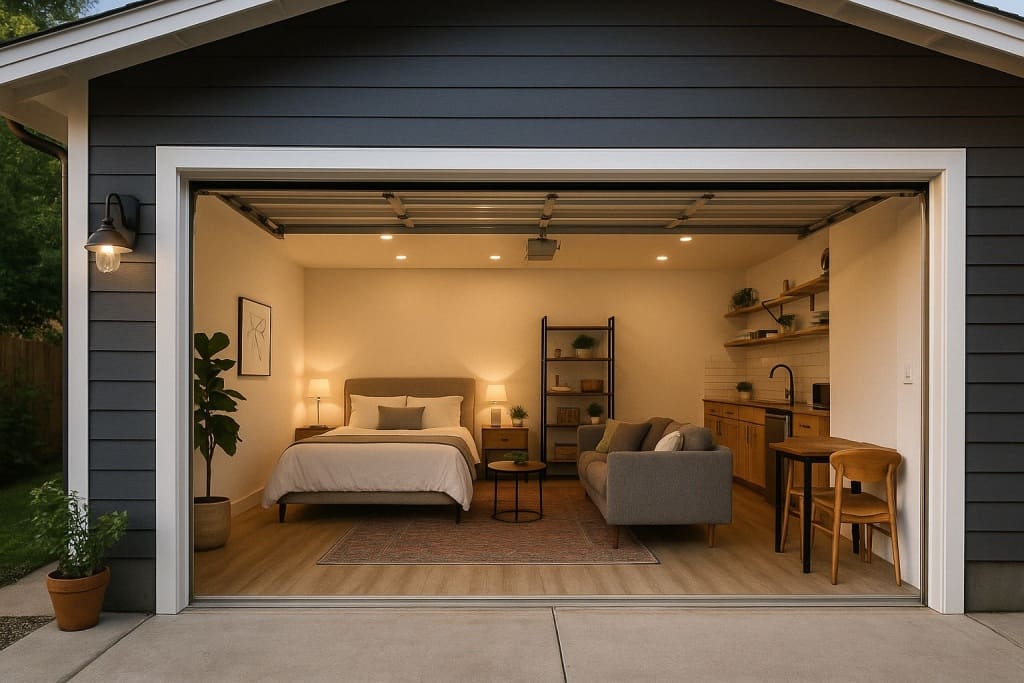
The reality: Under California ADU law, converting an existing garage, carport, or covered parking structure into an ADU requires no replacement parking at all — regardless of transit proximity, historic status, or the five exemptions above. This is a standalone protection specific to conversions.
The legislature recognized that requiring replacement parking for garage conversions would functionally block one of the most cost-effective ADU pathways — the entire point of encouraging conversions was undermined if homeowners then had to find room and money to build a new pad elsewhere on a property that likely doesn’t have space for one.
Where the myth persists: some jurisdictions historically imposed replacement requirements through local ordinance despite state law, and older departmental guidance in some cities hasn’t been fully updated. If a planner tells you replacement parking is required, ask them to cite the specific local ordinance overriding state law — in most cases none exists, and the confusion traces back to outdated guidance. Attached and detached garage conversions are treated identically under this protection.
Multi-Family Zoned Lots vs. Single-Family Neighborhoods
Single-family zoned lots follow the standard framework: one space per ADU or bedroom (whichever is less restrictive), subject to the five exemptions, plus the separate garage-conversion protection.
Multi-family zoned lots often operate under a more generous framework. Some jurisdictions apply reduced ratios for ADUs on multi-family properties since the underlying zoning already anticipates higher density. These lots are also more likely to fall within urban cores where the AB 2097 transit exemption applies, since multi-family zoning is disproportionately concentrated near transit corridors.
If your project sits on a duplex, triplex, or other multi-family zoned lot, don’t assume single-family rules apply by default — confirm your local zoning code’s multi-family ADU provisions specifically.
What to Do If Your City Gets This Wrong
Local planning departments don’t always apply these exemptions correctly, particularly where updates to state law haven’t been fully incorporated into published guidance. If your application is denied on parking grounds and you believe an exemption applies:
- Request the specific code citation the planner is relying on
- Cite Government Code Section 65852.2 directly, along with AB 2097 if the transit exemption applies
- Provide your walking-distance mapping exhibit as documentary evidence
- Escalate to a senior planner or the department’s ADU program manager if the reviewer isn’t current on state law
State preemption of local parking rules has been in place long enough that most experienced departments handle it correctly — but it’s worth knowing your rights before accepting a redesign requirement state law doesn’t actually support.
The Bottom Line
Parking has become one of the most misunderstood constraints in ADU planning, precisely because the exemptions are broader than most homeowners — and some planning staff — realize. Five separate conditions eliminate the requirement entirely, garage conversions get their own standalone protection, and the transit-distance calculation rewards careful documentation over assumption.
Before finalizing your design, run through all five exemption categories, confirm whether your project is a garage conversion, and generate proper walking-distance documentation if transit proximity is your path to exemption.
For help evaluating your property’s specific requirements, use the FindADUPros AI ADU Design Advisor. For vetted local contractors and designers, visit FindADUPros.
Frequently Asked Questions
Do I need to replace parking for a garage conversion ADU?
No. Converting an existing garage, carport, or covered parking structure into an ADU requires no replacement parking anywhere else on the property, regardless of transit proximity or historic district status. This covers both attached and detached garage conversions.
How close to public transit do I need to be for a parking waiver?
One-half mile walking distance, measured along actual sidewalks — not a straight-line radius. Two overlapping standards apply: the ADU statute’s general “public transit” definition and AB 2097’s stricter “major transit stop” definition, requiring a rail station, ferry terminal, or intersection of two major bus routes with 15-minute peak frequency.
What are all the ways I can be exempt from ADU parking requirements?
Five conditions each independently eliminate the requirement: proximity within a half-mile walk of transit, location in a historic district, conversion of an existing structure, unavailability of on-street parking permits for the occupant, or a car-share vehicle within one block. You only need to meet one.
Do multi-family zoned lots follow different parking rules?
Often, yes. Some jurisdictions apply reduced ratios for ADUs on multi-family properties, and these lots are more frequently located in transit-dense areas where AB 2097 applies. Confirm your local zoning code’s multi-family provisions rather than assuming single-family rules apply.
What if my city denies my application over parking that should be exempt?
Request the specific code citation, cite Government Code Section 65852.2 and AB 2097 directly, and provide a walking-distance mapping exhibit if transit proximity is your basis. Escalating to a department’s dedicated ADU program staff often resolves these disputes faster than continuing with the original reviewer.