
A contractor’s license number feels like proof enough. It isn’t. Licensing tells you someone passed an exam and met a state’s experience requirements. It says nothing about what happens if a worker falls off your ADU’s roof frame, or a subcontractor’s welding torch starts a fire that spreads to your existing house. That’s what insurance covers, and it’s a completely separate check from licensing that a surprising number of homeowners skip entirely. This ADU contractor insurance checklist walks through exactly what coverage to ask for, how to tell a real certificate from a worthless one, and the specific red flags that should stop you from signing a contract.
None of this replaces confirming your contractor is actually licensed, which you can do in a few seconds through our contractor license lookup tool. But license and insurance protect you from two different problems, and treating one as a substitute for the other is exactly how homeowners end up personally liable for an injury or a fire that happened on their own property.
Why a License Alone Doesn’t Cover You
A contractor’s license, a surety bond, and an insurance policy all sound like they’re doing the same job. They’re not.
A license confirms the contractor met a state board’s competency and experience requirements. A bond is a financial guarantee, usually a relatively small amount, that protects you if the contractor abandons the job or violates licensing law; it’s not designed to cover an injury or major property damage. Insurance is the coverage that actually pays out if someone gets hurt or something gets damaged during construction. A contractor can be fully licensed and bonded and still show up to your ADU project without a single active insurance policy, which leaves you personally exposed to any claim that arises on your property.

The Core Coverages You Need to Understand
A handful of policy types come up in nearly every serious insurance conversation about ADU construction, and each one protects against a different risk.
General liability is the foundation. It covers third-party bodily injury and property damage caused by the contractor’s work, a fire that spreads to your existing home, a burst pipe that floods a neighbor’s basement, a delivery driver who trips over material left in your driveway. Most sources recommend homeowners look for at least $1 million per occurrence and $2 million in aggregate coverage, though larger or more complex projects sometimes warrant higher limits.
Workers’ compensation covers medical costs and lost wages if one of the contractor’s employees gets hurt on your property. This is arguably the coverage homeowners underestimate most. If an uninsured worker is injured while building your ADU, you can be held personally liable for their medical bills, and that exposure exists regardless of how small your project is. As of January 2026, California’s SB 216 made workers’ compensation mandatory for every licensed contractor in the state, reflecting a broader trend of states tightening this requirement rather than loosening it.
Builder’s risk, sometimes called course-of-construction coverage, protects the structure itself and the building materials on site during construction against fire, wind, theft, and vandalism. This one gets overlooked constantly because homeowners assume their existing homeowners policy automatically extends to a construction project. It usually doesn’t. Builder’s risk needs to be explicitly arranged, and who carries it, the contractor or the homeowner, should be spelled out in your contract rather than assumed.
Commercial auto insurance matters when contractor vehicles are regularly on your property or transporting materials and equipment. A contractor’s personal auto policy typically doesn’t extend to business use, so this gap matters more than it initially seems.
Professional liability, or errors and omissions coverage, applies specifically to design responsibility. If your ADU project involves an architect, engineer, or designer providing stamped plans, this coverage protects against claims arising from a design error rather than a construction mistake.
Who Should Carry What?
There’s no single universal answer here, and any guide that claims otherwise is oversimplifying. Who’s responsible for which coverage depends on your specific contract language, your state’s requirements, and how your project is structured.
Never assume your own homeowners insurance policy automatically protects an active construction project. Most homeowners policies are written around occupied, finished structures, and a construction zone with material, equipment, and workers on site falls outside that coverage in ways that can surprise people at the worst possible moment. Before your ADU project starts, it’s worth a direct conversation with your own insurance agent about whether your policy needs an endorsement, a rider, or a separate builder’s risk policy for the duration of construction.
Your contract should explicitly state which party carries builder’s risk coverage, rather than leaving it as an assumed responsibility. This single clause is one of the most commonly missed details in owner-contractor agreements, and it’s worth confirming in writing before signing anything.
How to Read a Certificate of Insurance
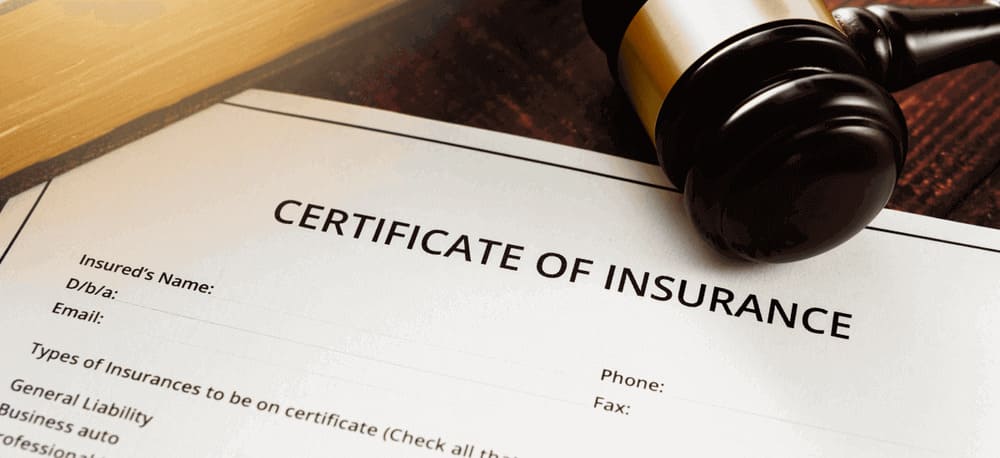
A certificate of insurance, commonly issued on a standardized ACORD 25 form, is a one-page summary of a contractor’s active policies. Knowing what to look for turns this from a confusing document into a five-minute check.
The named insured needs to match your contractor’s actual legal business name exactly, not a close variation or a name that only partially matches your contract. A mismatch here is one of the most common signs of a certificate that was issued for a different entity entirely.
Policy type should clearly list general liability and, where applicable, workers’ compensation, builder’s risk, and commercial auto. Each coverage type on the certificate should correspond to what you actually discussed with your contractor.
Effective and expiration dates need to cover your entire expected construction timeline, not just the date you’re signing the contract. A certificate that expires halfway through your build leaves a real gap unless it’s renewed and reissued.
The insurer name and policy numbers should be listed clearly enough that you could independently look up or call the company. A certificate missing this information, or listing an unfamiliar or unverifiable insurer, is a legitimate reason to ask more questions.
Coverage limits should match what your contract or project scope reasonably requires. A one-line general liability limit that seems unusually low for the size of your project is worth clarifying before you sign.
Additional insured language, where your name appears as an additional insured on the contractor’s general liability policy, gives you a more direct path to coverage if a claim arises. This isn’t always included automatically, and it’s worth explicitly requesting.
A project address listed on the certificate, when the insurer includes it, is a helpful confirmation that the policy actually applies to your specific job rather than being a generic certificate the contractor sends to every client.
How to Actually Verify a COI
Receiving a certificate is only half the job. Verifying it is the step a lot of homeowners skip, and it’s the one that catches forged, expired, or misrepresented documents.
Contact the insurer or agent listed on the certificate directly, using contact information you find independently rather than a phone number the contractor provides. This distinction matters more than it sounds like it should; a fraudulent certificate is far easier to produce than a fraudulent phone call routed through a real insurance company’s actual switchboard.
Ask the insurer to confirm the policy is currently active, that the named insured matches your contractor, and that the coverage limits match what’s printed on the certificate. This single call takes about five minutes and closes off the most common way homeowners end up trusting a lapsed or fabricated document.
For workers’ compensation specifically, several states maintain free public verification tools that let you check whether a specific employer carries active coverage on a given date, independent of anything the contractor hands you directly.
Insurance Red Flags Worth Stopping Over
A few signals should slow you down before you sign a contract or allow work to begin.
An expired certificate, or one whose dates don’t cover your full construction timeline, is a straightforward reason to request an updated document before proceeding.
A name mismatch between the certificate and your actual contract or business license is a serious flag, not a minor clerical issue, since it may mean the policy doesn’t actually apply to the entity doing your work.
A certificate you can’t verify with the issuing insurer, whether because the agent doesn’t confirm it or the insurer has no record of the policy, should stop the process entirely until it’s resolved.
No clear explanation for missing workers’ compensation is worth pressing on directly. A solo contractor with no employees might legitimately not carry workers’ comp in some states, but that explanation should come from the contractor clearly, not be left as an assumption on your part.
Watch specifically for what’s sometimes called a ghost policy, a workers’ compensation policy that technically exists but only covers the business owner while excluding every other worker on the crew. This type of policy can look completely valid on paper while leaving every actual worker on your job site uncovered, which is exactly the gap that leaves you exposed if someone other than the owner gets hurt.
Refusal to clarify who’s responsible for builder’s risk coverage during construction is a red flag worth resolving in writing before you sign, not something to leave as an unspoken assumption on either side.
Insurance After Completion: Personal Use vs. Rental ADU
Once your ADU is built, the insurance conversation doesn’t end; it shifts. A completed accessory dwelling unit typically needs to be added to your existing homeowners policy, and the specifics depend heavily on how you intend to use the space.
If the ADU is for personal use, housing a family member or serving as a home office, your insurer usually just needs to update your policy’s coverage amount to reflect the added structure’s replacement value.
If you’re renting the unit out, standard homeowners insurance often isn’t sufficient on its own. Many insurers require a landlord or rental-dwelling policy, or a specific rider, to cover a tenant-occupied structure on your property, along with liability protection specific to renting to a third party. Before you list the unit or sign a lease, a direct conversation with your own insurer about what your occupancy plan actually requires is worth having, since assuming your existing policy automatically extends to a rental arrangement is one of the more common and costly assumptions homeowners make after construction wraps up.

Building Your ADU Verification Checklist
Before signing a contract or allowing work to begin, confirm you have all of the following: a current certificate of insurance with general liability and, where applicable, workers’ compensation; effective dates covering your full project timeline; a named insured that exactly matches your contractor’s business name; verification directly from the insurer using independently sourced contact information; clear contract language on who carries builder’s risk coverage; and, ideally, additional insured status naming you on the general liability policy.
Running your project numbers through our ADU cost calculator or ADU loan calculator is a useful step while you’re still comparing contractors, since a properly insured builder’s pricing sometimes runs a bit higher than an uninsured one, and it’s worth understanding that difference as a real cost of risk transfer rather than a markup to negotiate away.
Don’t Sign Until You’ve Verified
Insurance verification takes a few phone calls and maybe twenty minutes of your time. Skipping it can leave you personally liable for an injury or a fire that happened on your own property, with no insurer standing behind the contractor to absorb that cost. Before you move forward with any ADU builder, confirm both license and coverage, and use our contractor license lookup tool alongside the verification steps in this checklist to make sure you’re covered from day one of construction.