
Building an ADU is one of the largest financial commitments a homeowner will make — often $150,000 to $400,000 or more. That kind of money attracts fraud. And in 2026, ADU contractor scams have become one of the fastest-growing categories of construction fraud in the United States.
This isn’t theoretical. Across California and Arizona alone, hundreds of homeowners lost millions of dollars in 2024 and 2025 to fraudulent ADU companies that collected large deposits, never pulled permits, and vanished. Some victims lost retirement savings. Others were left holding construction loans for projects that never broke ground — and mechanic’s liens from unpaid subcontractors they’d never even met.
This guide goes beyond the standard warning list. It covers the legal traps, the contract language red flags, and the exact steps to take before you hand over a dollar — and after, if things go wrong.
For vetted ADU professionals with verifiable permit histories in your market, FindADUPros is a free resource worth using before you commit to anyone.
Why ADU Construction Fraud Is Surging in 2026
The ADU boom created ideal conditions for ADU construction fraud. Demand is high, homeowners are eager, and the permit process is complex enough that a fraudulent contractor can credibly blame “city delays” for months. Project costs are large enough that a single score yields significant money — and sophisticated enough that most victims don’t realize they’ve been defrauded until the damage is done.
Arizona Attorney General Kris Mayes issued a formal warning in April 2026 about a growing pattern of construction fraud specifically targeting ADU homeowners — with some victims losing up to $250,000 after paying companies that collected large upfront payments, never obtained permits, and disappeared.
The pattern repeats across states. The names change. The script doesn’t.

The 7 Biggest ADU Contractor Scams & Structural Red Flags
1. Excessive Upfront Deposits and State Law Violations
The most consistent feature of ADU contractor scams is the large upfront payment demand. Legitimate contractors require deposits — typically 10–20% to secure a start date and cover initial materials. What separates a legitimate deposit from a scam is the amount, the timing, and whether it’s tied to milestone-based payments.
Fraudulent contractors push for 30%, 50%, or full payment before a permit is filed or a shovel hits the ground. They manufacture urgency — “material prices are rising,” “another client wants this slot” — to pressure homeowners before they’ve verified anything.
The Nonna ADU and Construction scam in Sacramento is a recent and damaging example. One homeowner paid $193,706.25 to Nonna Homes — of which $83,706.25 was paid before any physical work was performed. The CSLB ultimately suspended the license, canceled the bond, and filed an accusation to revoke it after receiving 23 complaints. In California, the CSLB home improvement contract deposit limit is 10% of the project cost or $1,000, whichever is less. Any contractor demanding more is violating California Business and Professions Code Section 7159.
Structure all payments around verified milestones tied to city inspector sign-off — foundation poured, framing inspected, rough mechanical approved. Never pay based on calendar dates.
2. The “Owner-Builder” Permit Avoidance Scheme
This is one of the most dangerous bad ADU contractor red flags — and one of the least discussed. Some fraudulent contractors tell homeowners: “To save money and skip city bureaucracy, pull the permit yourself as an Owner-Builder while I handle the construction.”
Do not do this. When a homeowner pulls an Owner-Builder permit, they assume full legal and financial liability for workplace injuries on the property, bypass the contractor’s insurance requirements, and shield the fraudulent builder from being tracked by state licensing boards. The contractor becomes invisible to regulators — while you hold all the risk.
Knowing how to check building permit status by address is your safeguard: once a permit is issued, any homeowner can search the city’s online portal to verify that it was pulled under the contractor’s license — not as an Owner-Builder. If it’s listed as Owner-Builder and you didn’t authorize that, stop payments and contact your state board immediately.
3. Identity Theft: Borrowing and Stolen License Numbers
This is among the most sophisticated ADU contractor warning signs and the hardest to detect without active verification. Fraudulent operations present a legitimate license number during the sales process — sometimes from another state, sometimes borrowed from a complicit local contractor, sometimes stolen.
The Arizona AG’s office documented that some fraudulent ADU operations pressure licensed contractors to allow their credentials to be used — leaving that licensed contractor legally exposed while the fraudulent company collects money and does nothing. If you need to file an Arizona Registrar of Contractors fraud complaint, use roc.az.gov. In California, verify every contractor at cslb.ca.gov.
The name on the license must match the company and individual you’re contracting with. Verify before you sign anything — not after.
4. Predatory Bundled Financing and Compounding Debt Footprints
The Multitaskr collapse in Southern California exposed a fraud pattern most homeowners hadn’t seen before. In fall 2024, Multitaskr shut its doors. More than 100 homeowners discovered their projects were abandoned or never started — and that they still owed money to lenders for construction loans Multitaskr had arranged. The average claim exceeded $200,000. Total losses may reach $48 million.
The mechanism: by arranging financing directly, Multitaskr ensured victims were indebted to lenders for work that never happened. The debt didn’t disappear when the company did.
Arrange your own financing independently — through your bank, credit union, or a HELOC. When a contractor offers to “handle financing,” get specifics in writing: who is the lender, what are the disbursement triggers, and what happens to the loan if the project is abandoned.
5. The Value-Engineering Bait-and-Switch
This scam operates after a valid permit is pulled — making it harder to catch. A contractor submits architectural plans showing code-compliant materials, gets approval, then swaps in cheaper substitutes during construction to pocket the price difference.
Common substitutions include:
- Replacing 2×6 framing studs with cheaper 2×4 studs, reducing structural integrity and insulation capacity
- Under-insulating walls in violation of California’s Title 24 energy codes — work that passes a visual inspection but fails thermal performance requirements
- Installing standard subfloors in flood-prone zones without the required elevation or anchoring specified in the approved plans
- Substituting approved roofing materials with lower-rated products that won’t show defects for years
Request an independent third-party inspection at framing stage — before walls are closed. A licensed inspector comparing actual materials against the approved plan set catches substitutions while correction is still possible and inexpensive.
6. Scope-Creep Manipulation
This is the fraud pattern that doesn’t always rise to criminal levels but routinely costs homeowners $30,000–$80,000 above their contracted price. The contractor bids low to win the job, then systematically introduces change orders — “unforeseen conditions,” “code upgrades,” “material shortages” — once the homeowner is too financially invested to walk away.
Signs scope creep is being manufactured rather than discovered:
- Change orders arrive within the first two weeks, before excavation or demolition has revealed actual conditions
- Signatures are requested under time pressure (“we need to order materials today or lose the price”)
- “Code requirements” are cited without a specific code section referenced
- Cumulative change orders exceed 25–30% of the original contract price
A legitimate contract requires a written, signed change order with specific justification and a revised project total before any additional work proceeds. Build a 10–15% contingency into your original budget so genuine surprises don’t become emergencies.
7. Fake References and Manufactured Online Presence
Sophisticated scammers actively manipulate the verification layer most homeowners rely on. Fake Google reviews, fabricated testimonials, and reference calls that connect to accomplices rather than actual clients are all documented in contractor scam prevention literature.
Nonna ADU and Construction had built a credible public profile — named one of Sacramento’s fastest-growing companies by the Sacramento Business Journal in 2025 — before complaints surfaced and the CSLB suspended the license. A compelling origin story is not verification.
Ask for the addresses of three completed ADU projects — not phone numbers. Search those addresses on the city’s permit portal to confirm permits were pulled and finaled. A legitimate company welcomes this. A fraudulent one stalls or provides addresses that don’t match permit records.
The Mechanic’s Lien Trap: How Scammers Leave You Liable to Subcontractors
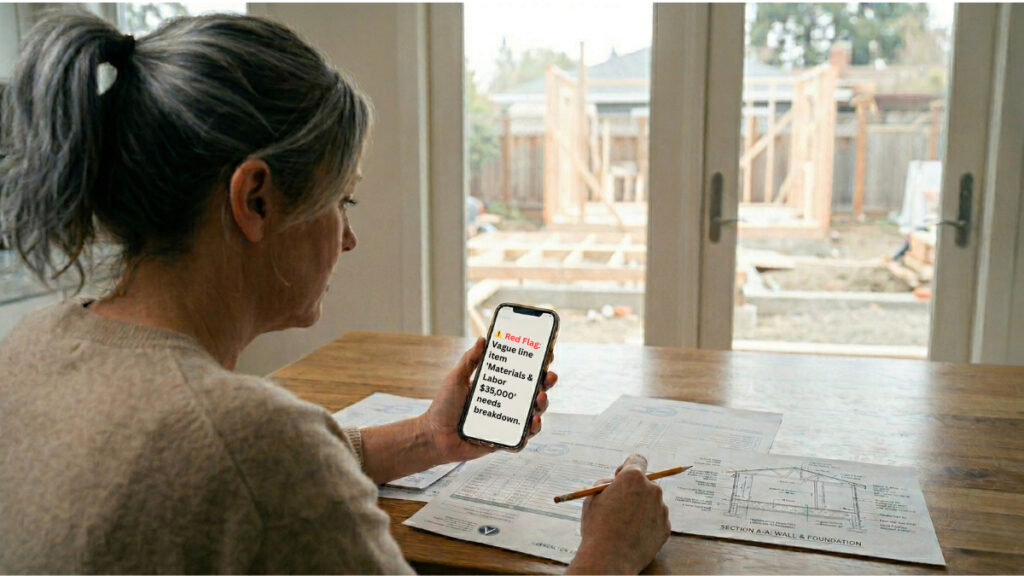
This is the most financially devastating hidden risk in ADU construction fraud — and the one most homeowners only learn about after it’s too late.
When a predatory general contractor goes dark, they often stop paying their material suppliers (lumber yards, concrete companies) and specialty subcontractors before disappearing. Under state laws — including California Civil Code — those unpaid suppliers can file a mechanic’s lien against your property. This means even if you paid the general contractor in full, you could be legally required to pay the subcontractors again or face foreclosure proceedings.
The Nonna Homes case made this explicit: one homeowner received a $6,400+ lien from building supply companies for materials ordered by Nonna — materials for a project the homeowner had already paid for.
How to protect yourself: Demand conditional and unconditional lien waivers with every milestone payment. A conditional lien waiver confirms a subcontractor or supplier will release their lien rights upon receiving payment. An unconditional lien waiver confirms they have been paid and waive all future lien rights. Never release a milestone payment without a signed waiver from every subcontractor and supplier who worked in that phase.
⚠️ Predatory ADU Contract Clauses to Redline Immediately
If you spot any of these in a proposed ADU contract, refuse to sign until they are removed or rewritten:
- “Estimated Permit Timelines / Verbal Approvals”: The contract must state that no significant funding is released and work does not commence until a physical, numbered building permit is issued by the local municipality
- “Payment Due on Calendar Dates”: Never agree to “Third payment of $40,000 due October 1st.” If the contractor delays two months, you become contractually in default. Rewrite to: “Payment due only upon city inspector sign-off of rough framing”
- “Arbitration via Hidden Providers”: Mandatory arbitration clauses tied to private, out-of-state firms prevent you from suing in local small claims or civil court. Strike these entirely
- “Blanket Change-Order Allowances”: Any clause giving the contractor unilateral right to adjust prices without your explicit signature on a written change order — delete it
- Missing Cancellation Notice: Federal FTC rules and state home improvement laws (including California’s Home Solicitation Act) give you a mandatory 3-to-5 business day right to cancel any contract signed at your home without penalty. A legitimate contract must include this physical cancellation form. If it’s missing, the contract may be unenforceable — and a reputable contractor will include it without being asked
Pre-Contract Verification Checklist: Protect Your $100K+ Investment
Before signing any ADU construction contract, complete every step below:
- License check: Verify on your state board’s website — CSLB (California), ROC (Arizona). Confirm the name, license status, bond status, and open complaints
- Insurance verification: Request a certificate of insurance directly from the insurer — not from the contractor. Call to confirm it’s current and covers the full project value
- Permit history: Ask for addresses of completed ADU projects. Search those addresses to confirm permits were pulled and finaled — and were not pulled as Owner-Builder
- Lien waiver requirement: Confirm the contract requires conditional and unconditional lien waivers with every milestone payment
- Deposit cap compliance: Confirm the deposit is within your state’s legal limit (10% or $1,000 in California, whichever is less)
- Independent financing: Arrange your own financing through a bank, credit union, or HELOC — never through the contractor
- Cancellation form: Confirm a physical right-to-cancel notice is included in the contract package
Step-by-Step Recovery: What to Do If an ADU Builder Abandons Your Site
If you’ve paid a contractor who has stalled, gone quiet, or disappeared:
- Stop all payments immediately. Do not send additional money under any circumstances, even if the contractor reappears with explanations.
- Photograph and video record the entire site before hiring anyone else to touch it. This documentation is the foundational evidence required for state recovery fund claims, bond disputes, and litigation.
- Obtain a certified independent inspection. Hire a licensed third-party engineer or contractor to produce a written evaluation of the exact value of work performed versus money paid. This document is essential for winning any bond claim or legal action.
- File a complaint with your state licensing board. The CSLB in California and the ROC in Arizona investigate contractor fraud, pursue license revocation, and process bond claims against contractors on homeowners’ behalf.
- File with your state’s Attorney General. The Arizona AG’s April 2026 warning originated directly from homeowner complaints that triggered a statewide investigation.
- Contact your lender immediately if contractor-arranged financing is involved. Document that work was not performed and request guidance on disputing disbursements.
- Consult a construction attorney. Many work on contingency for fraud cases involving bond claims. A construction attorney for an abandoned home renovation can also initiate mechanic’s lien defense proceedings if supplier liens have been filed against your property.
The Bottom Line
ADU construction fraud follows predictable patterns. Large deposits before permits. Permits never pulled. Subcontractors not paid. Mechanics’ liens filed against homeowners who already paid in full. Bundled financing that survives the contractor’s disappearance.
The homeowners who avoid it are almost always the ones who slowed down, verified independently, demanded lien waivers with every payment, and read every clause before signing. The ones who got hurt were usually the ones who trusted a polished sales pitch over a paper trail.
For vetted ADU contractors with verifiable permit histories and independently confirmed references in your area, visit FindADUPros before you commit to anyone.