Phoenix is one of the most ADU-friendly cities in America right now — and that’s not an accident. Between Arizona’s sweeping HB 2720 legislation and the city’s own expanded guest house rules, the window for building a casita or detached guest house has never been wider. But “friendly” doesn’t mean simple. Phoenix’s desert climate, a patchwork of HOA communities, and some quirky septic realities on the outskirts mean there’s plenty that can trip up a homeowner who doesn’t know the local landscape.
This Phoenix ADU guide covers everything you need to plan your project in 2026: what things actually cost here, how the permitting process works, what your HOA can and can’t do, and why building in Phoenix demands a different approach than building almost anywhere else in the country.
For vetted local contractors and ADU resources specific to Arizona, FindADUPros is a strong starting point.
Casita vs. ADU: Does the Terminology Matter in Phoenix?
They Mean the Same Thing — Mostly
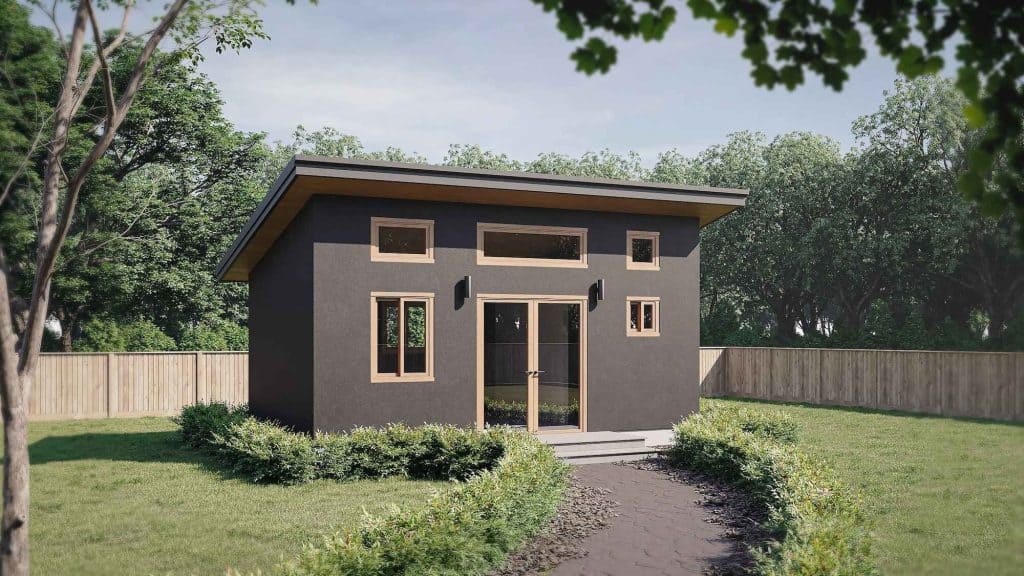
In Arizona, the words “casita,” “guest house,” and “ADU” are used almost interchangeably — by homeowners, contractors, and even city officials. The City of Phoenix’s own ADU guide lists “guest houses, casitas, or granny flats” as synonymous terms for accessory dwelling units.
The functional distinction is this: a casita or guest house without a full kitchen is generally considered a non-habitable accessory structure under older zoning language. Once you add a kitchen — meaning a sink, cooking facility, and refrigeration — it becomes an ADU under Phoenix’s current code. That kitchen requirement is what triggers the full permitting, utility, and zoning review process.
For most homeowners, this distinction is academic. If you’re building a self-contained unit for a family member or tenant, you’re building an ADU — call it what you like.
What Arizona Law Now Allows (HB 2720 + HB 2928)
The Legal Foundation in 2026
Arizona’s ADU landscape changed dramatically with House Bill 2720, signed by Governor Katie Hobbs on May 21, 2024, and effective January 1, 2025. The law mandates that any Arizona municipality with a population over 75,000 must allow at least one attached and one detached ADU per single-family residential lot. Phoenix, as the state’s largest city, sits squarely within its scope.
Then came House Bill 2928, signed May 23, 2025, which extended nearly identical requirements to counties — closing the gap for homeowners in unincorporated Maricopa County who weren’t covered by the original law. Counties had to adopt compliant regulations by January 1, 2026.
What this means practically for Phoenix homeowners in 2026:
- Two ADUs per lot are permitted in single-family residential zones — one attached, one detached
- A third ADU is possible on lots of one acre or larger, provided at least one unit qualifies as an affordable dwelling
- Size limits: Each ADU can be up to 75% of the primary home’s gross floor area, capped at 1,000 sq ft on lots up to 10,000 sq ft, and up to 3,000 sq ft on larger lots
- Owner-occupancy is not required. Arizona eliminated this requirement in 2023 — you don’t need to live on the property to build or rent an ADU
- Short-term rentals are prohibited. Phoenix explicitly bans ADUs from operating as short-term rentals; long-term leases are permitted
Zoning Still Matters
HB 2720 sets the floor, but your individual zoning district still governs setbacks, height limits, and lot coverage. Setbacks in Phoenix follow the underlying zoning district rather than a single citywide standard — and a handful of zones including RE-43, RE-24, RE-35, and R1-14 carry different rules than the more common R1-6 and R1-10 designations.
Use Phoenix’s My Community Map to confirm your zoning district before drawing up any plans. It’s a five-minute step that can save weeks of rework later.
How Much Does a Casita Cost in Phoenix in 2026?
The Honest Numbers
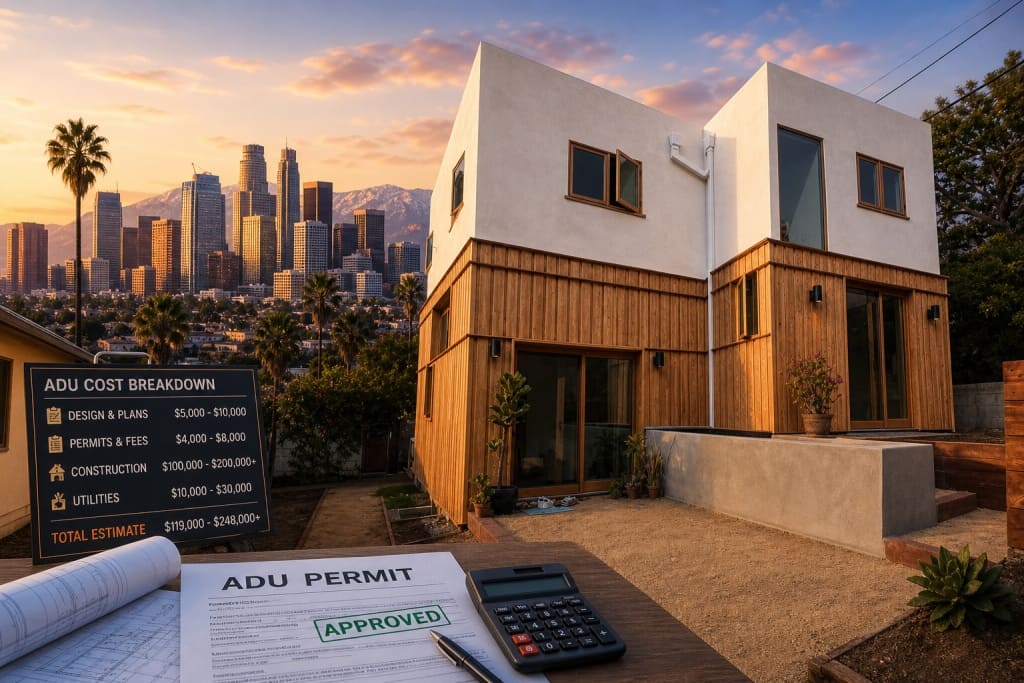
Building in Phoenix costs more than the national average — and the gap has widened in recent years. Current costs run approximately $325–$375 per square foot for standard finishes, with total project ranges roughly as follows:
- Studio or one-bedroom (400–600 sq ft): $140,000–$210,000
- One to two-bedroom (600–900 sq ft): $200,000–$320,000
- Larger detached casita (900–1,000 sq ft): $300,000–$375,000+
Permit and fee costs add $10,000–$25,000 on top of construction costs, covering building permits, development impact fees for water, sewer, parks, fire, police, library, and streets.
What’s driving Phoenix costs above national norms? Three things: heat, labor, and material logistics.
The Phoenix Heat Premium
This is the factor most homeowners underestimate. Building a livable ADU in a climate that routinely hits 115°F in summer isn’t the same as building in Portland or Denver. Advanced cooling systems required for Phoenix’s extreme heat add approximately $2,000–$5,000 to the project compared to national averages — and that’s before accounting for the additional insulation, window specifications, and radiant barrier requirements that Phoenix building code demands.
Phoenix building code follows the IECC 2021 energy efficiency standards, which means your ADU needs:
- High-efficiency HVAC — a mini-split heat pump is the standard choice for small ADUs in Phoenix; they’re more efficient in extreme heat than traditional AC units
- Radiant barrier roof sheathing — mandatory in Phoenix’s climate zone to reflect solar heat gain before it reaches the living space
- Low solar heat gain coefficient (SHGC) windows — Phoenix code requires windows that limit how much solar radiation enters the unit
- Continuous exterior insulation or advanced framing — standard framing alone doesn’t achieve code-required envelope performance in this climate
These aren’t optional upgrades. They’re code minimums — and getting them right from the start is far cheaper than fixing an uncomfortable, energy-inefficient unit after the fact.
Labor and Material Costs
Construction labor in Phoenix has increased 15–20% since 2022 due to sustained construction demand across the metro area. Skilled tradespeople — electricians, plumbers, framers — are in short supply relative to the volume of work, and wages have risen accordingly and aren’t expected to decline. Budget for this reality rather than hoping for a discount.
Water conservation requirements add another $1,000–$3,000 to plumbing costs, driven by Phoenix’s mandatory low-flow fixture standards and, on some projects, greywater pre-plumbing requirements.
The Phoenix ADU Permit Process: What to Expect
A Step-by-Step Breakdown
Getting ADU permits in Phoenix follows a defined sequence. Understanding it upfront lets you plan your timeline and budget realistically. Here’s how it works:
- Confirm your zoning and lot coverage. Use My Community Map for your zoning district and the Maricopa County Assessor to calculate your current lot coverage. ADUs must stay within the coverage limits for your zone.
- Prepare your plans. You’ll need a scaled site plan showing ADU size, placement, setbacks, and planned utility connections. Construction drawings must meet Phoenix zoning and building code requirements.
- Consider using the City’s free standard plan library. The City of Phoenix partnered with AIA Phoenix Metro in 2024 to develop pre-approved ADU designs available free to residents. Using one eliminates the design review stage and can meaningfully reduce your timeline and architectural fees — a genuine budget advantage.
- Submit through SHAPE PHX. Applications go through Phoenix’s online ePlans portal or in person at Phoenix City Hall at 200 W. Washington Street, 2nd Floor.
- Plan review. City staff review for zoning and building code compliance. Residential plan review runs 10–15 business days, with an express residential option available for qualifying projects. Build time for at least one revision cycle into your schedule — resubmissions are common.
- Permit issuance and construction. Once permits are issued, construction begins. Inspections happen at set stages: foundation, framing, rough mechanical/electrical/plumbing, and final.
- Certificate of Occupancy. After a final inspection confirms code compliance, the city issues a Certificate of Occupancy. The ADU is legal to occupy.
Real-World Timeline
From initial design to move-in, expect 6–8 months for a typical Phoenix ADU project. Historic district properties face additional design review that can add 4–8 weeks. One practical note: Phoenix’s building season runs roughly October through May. Summer construction isn’t impossible, but it requires schedule adjustments for heat — outdoor concrete work and framing slow down significantly above 105°F, and worker productivity drops in peak summer months. Projects that break ground in fall tend to run more smoothly.
HOA Restrictions: What Phoenix HOAs Can and Can’t Do
Arizona Law Limits HOA Authority — But Doesn’t Eliminate It
Arizona eliminated the ability of HOAs to categorically ban ADU construction when it enacted HB 2720. An outright prohibition written into CC&Rs is no longer enforceable against a project that complies with state law. That’s the good news.
The less straightforward news is what HOAs can still do:
- Enforce reasonable design standards — requiring that your casita match the primary home’s roofline, exterior materials, or color palette is generally permissible
- Apply setback rules — as long as those setbacks don’t exceed what local zoning already requires
- Restrict short-term rental use — a significant one in Phoenix, where the city already prohibits ADU short-term rentals citywide
- Require architectural review board (ARB) approval — the process is still required, even when the HOA cannot legally deny a compliant project
What HOAs cannot do is use the ARB process as a tool for indefinite delay, impose design requirements so onerous they make construction economically impossible, or deny a project without citing specific enforceable provisions in the CC&Rs.
If you’re in an HOA community, pull your CC&Rs before finalizing plans. In Phoenix’s newer master-planned communities — many of which were developed after ADU law was looser — some governing documents contain restrictive language that, while no longer fully enforceable, can still create friction and delay. Knowing what you’re dealing with before you submit saves time.
Septic Considerations on the Phoenix Outskirts
A Reality Check for Homes Outside City Sewer Service
Not every property in the Phoenix metro sits on municipal sewer. Homes in Cave Creek, unincorporated Maricopa County, and some outer-ring areas of the metro still rely on on-site wastewater treatment — a septic system — and adding an ADU triggers a direct review of whether that system can handle the additional load.
Maricopa County’s Environmental Services Department maintains records of all permitted septic systems in the county. Before permitting an ADU on a septic-served property, you’ll need to demonstrate that your existing system can accommodate the increased fixture count and wastewater volume — or upgrade it. Adding a full kitchen and bathroom to a property that’s already near its septic system’s design capacity can require a system expansion or replacement, adding $8,000–$25,000 or more to your project budget.
For properties in unincorporated Maricopa County specifically, Maricopa County’s permitting rules differ from Phoenix city ordinances on size limits, setbacks, and procedures. If your address falls outside Phoenix city limits, verify requirements directly with Maricopa County Planning and Development — not the City of Phoenix — before spending anything on design.
The practical checklist for septic-served properties:
- Look up your septic system permit records through the Maricopa County Environmental Services online database
- Get a septic inspection and capacity assessment before finalizing ADU plans
- Include potential septic upgrade costs in your budget contingency
- Confirm whether your county has adopted HB 2928-compliant ADU regulations — most had to do so by January 1, 2026
Practical Tips to Keep Your Phoenix ADU on Budget
Phoenix-specific cost discipline goes beyond the general ADU budgeting advice that applies anywhere. A few things that matter more in this market:
- Use the city’s free standard plan library. It’s a genuine cost and time saver that too few Phoenix homeowners know about. Pre-approved plans eliminate design fees and speed plan review.
- Don’t undersize the HVAC. An undersized mini-split in a Phoenix summer isn’t just uncomfortable — it runs constantly and fails early. Size it right the first time.
- Time your construction start for October. Starting in fall lets you complete the structural work before summer, when exterior trades slow down and productivity drops.
- Get a septic capacity assessment early if you’re outside city sewer service. Discovering a system upgrade is needed after permits are submitted adds months and thousands to your project.
- Verify your lot coverage before anything else. Phoenix’s updated guest house rules added 10% coverage allowance in most zones, but exceeding your lot’s coverage limits requires a variance — a process that adds time and cost that no one wants mid-project.
The Bottom Line
Phoenix in 2026 is genuinely one of the better places in the country to build an ADU. State law has cleared the biggest legal obstacles, the city has built a pre-approved plan library to reduce costs, and two-unit-per-lot capacity means most homeowners have real options. The challenges are real too: construction costs run high here, the desert climate demands more from your building envelope and mechanical systems than most markets, and HOA communities and septic-served lots each add a layer of complexity that rewards doing your homework upfront.
Get your zoning confirmed, look into the city’s free standard plans, understand your HOA’s actual authority, and if you’re on septic, get a capacity check before you commit to anything.
For local contractor referrals, ADU design resources, and help navigating Arizona-specific rules, visit FindADUPros.
Frequently Asked Questions
What is the difference between a casita and an ADU in Phoenix?
In Phoenix, the terms are used interchangeably. The City of Phoenix’s official ADU guide lists casitas, guest houses, and ADUs as synonymous. The functional distinction is that a unit with a full kitchen — sink, cooking facility, and refrigeration — is classified as an ADU and triggers full permitting and utility review.
How much does it cost to build a casita in Phoenix in 2026?
Expect $325–$375 per square foot for standard finishes, with a studio or one-bedroom ADU running $140,000–$210,000 and a larger detached casita approaching $300,000–$375,000. Permit and impact fees add $10,000–$25,000. Heat-related construction requirements — cooling systems, radiant barriers, high-performance windows — add $2,000–$5,000 above national averages.
How long does it take to get ADU permits in Phoenix?
Residential plan review runs 10–15 business days, with an express option available for qualifying projects. Build in time for at least one revision cycle. From initial design to final Certificate of Occupancy, most Phoenix ADU projects take 6–8 months total.
Can my HOA stop me from building a casita in Phoenix?
No — Arizona law prohibits HOAs from categorically banning ADU construction. Your HOA can still enforce reasonable design standards and require architectural review board approval, but it cannot use that process as a blanket denial or impose requirements so extreme they make construction impossible.
Do I need to upgrade my septic system to build an ADU?
If your property is served by an on-site septic system rather than municipal sewer, you’ll need to verify that your existing system has capacity for the additional dwelling unit. If it doesn’t, an upgrade or expansion is required — which can add $8,000–$25,000 to your project. Get a capacity assessment early, before finalizing plans or submitting permits.
Can I use my Phoenix ADU as an Airbnb?
No. Phoenix prohibits ADUs from operating as short-term rentals. Long-term leases are permitted.