
Once homeowners estimate the cost of building an ADU, the next question is usually about the ADU Property Tax Increase. Many worry that adding an ADU will trigger a full reassessment of their home’s value and significantly raise their property taxes. In reality, this concern is often based on a misunderstanding of how ADU property tax assessments work.
The short answer is yes, building an ADU does increase property taxes — but not in the way most homeowners fear. The increase is real, predictable, and in most cases, modest enough that a single month’s rent more than covers it. Understanding exactly how your ADU tax assessment is calculated is what separates homeowners who build with confidence from those who stall indefinitely on a decision that would have paid off years ago.
Does Building an ADU Increase Property Tax?
Yes—but only for the new ADU, not your entire property.
Adding an ADU does not usually trigger a full reassessment of your home. In California, for example, your existing home’s assessed value remains protected under Proposition 13, while many other states have similar protections.
Instead, the assessor performs a blended assessment, valuing only the newly built ADU and adding that amount to your current assessed value. The primary home’s existing assessment is not reset.
This approach generally applies in states such as California, Oregon, Texas, Washington, and Florida: new construction increases your property’s assessed value only by the value of the addition, not the entire property.
How the Blended Assessment Is Calculated
The county assessor typically determines your ADU’s assessed value in one of three ways:
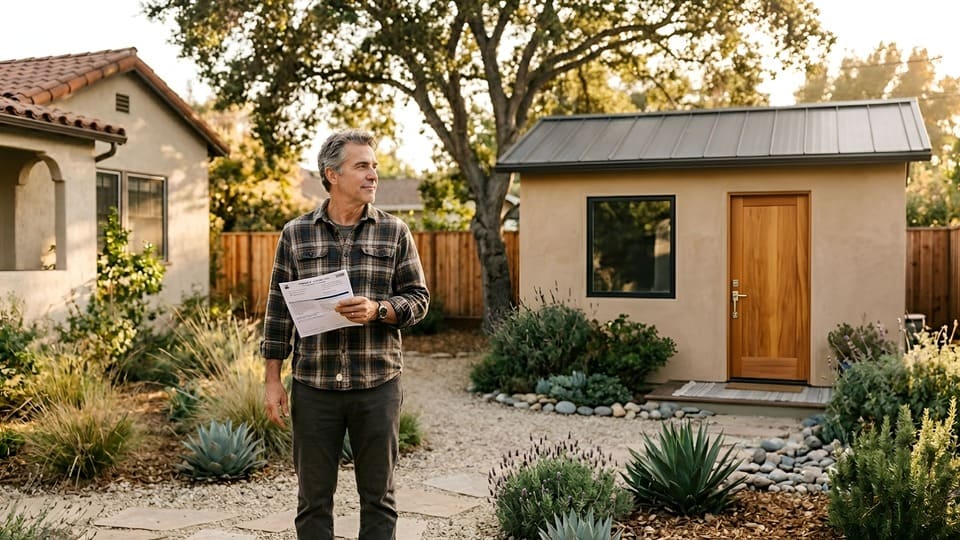
1. Construction cost. After your building permit is finaled, the assessor’s office mails a form titled “Property Owners Declaration of New Construction” requiring you to report construction costs. Those costs become the primary basis for the ADU’s assessed value.
2. Market comparisons. In some counties, the assessor cross-references your ADU against comparable properties rather than relying solely on your reported costs. San Diego County assessors often use standardized valuations of $130–$165 per square foot to determine the taxable value of an ADU.
3. Income potential. Less commonly, assessors in some jurisdictions factor in the unit’s income-generating capacity, particularly if the ADU is actively rented at market rates.
Once the ADU’s value is established, your new annual property tax bill equals:
New total assessment × local tax rate = new annual tax bill
In California, the base rate is 1% under Proposition 13 — though most counties stack local bond measures, school levies, and special assessments on top, pushing effective rates to 1.1%–1.3%+ in many areas. Your final number will reflect your county’s actual effective rate, not just the 1% baseline.
Real Dollar Examples: What the Increase Actually Looks Like
These are real-world numbers based on how assessors value ADUs in practice:
| ADU Construction Cost | Typical Assessed Value | Annual Tax Increase (at 1.1% effective rate) | Monthly Impact |
|---|---|---|---|
| $100,000 | $90,000–$100,000 | $990–$1,100/yr | $83–$92/month |
| $150,000 | $135,000–$150,000 | $1,485–$1,650/yr | $124–$138/month |
| $200,000 | $175,000–$200,000 | $1,925–$2,200/yr | $160–$183/month |
| $300,000 | $265,000–$300,000 | $2,915–$3,300/yr | $243–$275/month |
In California, property taxes are typically about 1% of the assessed value. A $150,000 ADU may increase your annual property tax by around $1,500, or about $125 per month.
By comparison, a 600-square-foot one-bedroom ADU can often rent for $1,800–$3,000 per month. In most cases, the additional property tax is small relative to the potential rental income.

Proposition 13 and What It Actually Protects
California’s Proposition 13 — passed in 1978 — caps annual property tax increases at 2% per year, regardless of how much the market value of your property rises. This protection applies both to your primary home and to your ADU once it’s assessed.
What this means in practice:
- Your primary home’s assessed value continues to grow at a maximum of 2% per year, just as it did before the ADU was built
- Your ADU receives its own assessed value at the time of completion, which then also grows at a maximum of 2% per year going forward
- There is no “reset” of your existing property assessment triggered by ADU construction
California’s Proposition 13 protects the current assessed value of your main house from increasing more than 2% per year after the initial assessment. This means your property taxes will only increase based on the added value of your ADU, not the entire property.
Three common myths that Proposition 13 directly contradicts:
- “My entire house will be reassessed at the current market value.” False. Only the ADU receives a new assessment.
- “Building an ADU will change my property’s tax classification.” False. A residential ADU on a residential lot remains classified as residential property.
- “If I don’t rent the ADU, no tax is assessed.” False. ADU taxes are assessed based on the structure’s value, not its use.
SB 1164: The Tax Deferral Most Homeowners Don’t Know About
This provision can significantly improve the financial outlook for many California homeowners and is often overlooked in ADU guides.
California’s SB 1164 allows eligible homeowners to defer reassessment of a new ADU for up to 15 years or until the property is sold. To qualify, you must notify the county assessor within 30 days of completing construction and confirm the unit will be used as housing.
For eligible homeowners, this can delay the ADU-related property tax increase during the years when construction loans are often still being repaid, improving short-term cash flow.
The benefit is not automatic. Missing the 30-day notification deadline means the ADU’s assessed value will be added to the tax roll with the next billing cycle, so plan to submit the required paperwork as soon as construction is complete.
The 2026 Update: ADUs Under 500 Sq Ft
California updated its ADU law effective January 1, 2026, with changes that may affect property taxes for smaller units.
Under the updated law, ADUs with less than 500 square feet of livable space are treated differently for assessment purposes, potentially reducing their taxable impact.
In practice, studios, JADUs, and other ADUs under 500 sq ft may receive a lower assessed value than larger units. Because implementation can vary by county, check with your local assessor before finalizing your ADU design.
Use the FindADUPros Zoning Information Lookup to check how your jurisdiction is applying this 2026 update before locking in your ADU’s size.
How ADU Taxes Work in Other States
California’s Proposition 13 framework is the most protective in the country — but homeowners elsewhere face similar mechanics with different specifics:
Texas: No state income tax, but property taxes are set at the county level and generally run 1.5–2.5% of assessed value — significantly higher than California’s base rate. ADU additions are treated as new construction and assessed accordingly. No equivalent to Proposition 13’s annual cap, meaning increases can be more significant year over year.
Washington: Some jurisdictions offer temporary property tax exemptions for ADUs under specific affordability conditions. Without an exemption, ADU additions are assessed as new construction at the county’s standard rate.
Oregon: Property taxes are based on assessed value (not market value) with annual increase limits similar in concept to California’s approach. ADUs are treated as new construction additions and assessed separately from the primary home.
Florida: ADUs are assessed at just value (market value) and added to the property’s total assessment. The Save Our Homes cap limits annual increases to 3% for homesteaded properties — but only applies to the existing home’s assessment, not the new ADU addition.
The pattern is consistent across states: the ADU adds to your assessment without triggering a full-property reassessment.
The Rental Income Offset: Where the Math Gets Interesting
Building an ADU increases your property taxes. Renting it generates income that dwarfs that increase. But if you use the ADU as a rental, the tax picture improves further through federal deductions.
When an ADU is used as a rental property, you can deduct:
- Depreciation: The ADU’s structure (not land value) depreciates over 27.5 years under Schedule E — a non-cash deduction that reduces taxable rental income
- Operating expenses: Maintenance, property management fees, insurance, and utilities you pay can all be deducted against rental income
- Mortgage interest: If you used a HELOC or loan to finance construction, the interest portion may be deductible as a rental expense
These deductions can substantially reduce your net taxable rental income — and in some cases, the depreciation deduction alone can offset a significant portion of the rental income for tax purposes, improving your effective after-tax return well beyond what the gross rent figure suggests.
ADU construction costs are not immediately tax-deductible. However, if the ADU is used as a rental property, homeowners can benefit from long-term tax advantages, including depreciation and operating expense deductions.
Use the FindADUPros ADU Loan Calculator to model how your financing costs interact with rental income and tax deductions before you commit to a loan structure.
Does an ADU Property Tax Increase Make Financial Sense?
Run the numbers against the specific context of your property, your market, and your intended use:
For rental-focused homeowners: The ADU property tax increase on a $200,000 build is roughly $160–$183/month. A market-rate one-bedroom ADU in most California metros generates $1,800–$3,000/month. The tax increase represents 6–10% of gross rental income — before depreciation deductions further reduce the net tax burden.
For multigenerational living: There’s no rental income to offset the tax increase, but there may be savings on alternative housing costs (assisted living, apartment rent for a family member) that exceed the annual tax addition by multiples.
For resale: ADUs can boost resale value by up to 30% in California. On an $800,000 property, that could mean an added $240,000 in equity. A $2,000–$3,000 annual tax increase against a $240,000 equity gain is a favorable trade by almost any measure.
The honest answer to whether an ADU property tax increase makes sense is almost always yes — because the increase is limited, predictable, and offset by the financial benefits the ADU creates.
What to Do Before and After Construction
Before construction:
- Confirm your county’s current ADU assessment methodology (cost-basis, market comparison, or income-based)
- Check whether your jurisdiction is applying the 2026 sub-500 sq ft assessment update
- Explore SB 1164 deferral eligibility and set a calendar reminder for the 30-day post-completion notification window
- Model your projected annual tax increase against expected rental income using the FindADUPros ADU Cost Calculator
After construction:
- When you receive the “Property Owners Declaration of New Construction” form, respond accurately with your construction costs — this is how the assessor determines your ADU’s taxable value
- If you qualify for SB 1164 deferral, notify the county assessor within 30 days of completion
- If you rent the ADU, begin keeping clean records of rental income and expenses from day one — these become critical for Schedule E depreciation and deduction purposes
For help navigating your specific market’s ADU cost and tax landscape, visit FindADUPros.
Frequently Asked Questions
Does building an ADU increase property taxes?
Yes—but only for the new ADU, not your entire property. Under California’s Proposition 13 and similar rules in some other states, adding an ADU does not reset your home’s assessed value. Only the ADU is assessed and added to your existing value, typically increasing annual property taxes by about 1–1.5% of the ADU’s assessed value.
How much will my property taxes go up if I build an ADU?
At a 1.1% effective tax rate, expect roughly $1,100–$1,500/year for a $100,000–$150,000 ADU, and $2,000–$3,000/year for a $200,000–$300,000 build. That works out to $90–$250/month — typically well below what the unit generates in monthly rental income.
What is a blended assessment?
A blended assessment means the county assessor values only the new ADU and adds that amount to your existing property assessment. Your primary home’s assessed value stays unchanged, avoiding a full-property reassessment.
What is SB 1164 and how does it help ADU owners?
California’s SB 1164 allows eligible homeowners to defer an ADU’s property tax reassessment for up to 15 years or until the property is sold. To qualify, notify your county assessor within 30 days of completion and confirm the unit will be used for housing. Depending on the ADU’s value and local tax rate, this could save tens of thousands of dollars in deferred property taxes.
Can I deduct my ADU from my taxes?
Construction costs are not immediately deductible. However, if the ADU is rented out, you may claim depreciation over 27.5 years, deduct operating expenses and eligible loan interest, helping offset some or all of the additional property tax.