Florida’s multigenerational housing demand is exploding, and Miami-Dade has responded with genuinely functional ADU regulations — a pre-approved design library, clear zoning eligibility, and a defined permitting pathway. For a county with more than 171,000 eligible lots and one of the most competitive rental markets in the state, the opportunity is real.
The complexity is real too. Miami-Dade sits in a High-Velocity Hurricane Zone, meaning every ADU must meet wind-resistance standards found nowhere else in the country outside Broward County. Add HOA restrictions that can override county zoning, plus an owner-occupancy rule that trips up more homeowners than any other requirement, and building a guest house in Miami requires a different playbook than Phoenix or San Diego.
Use the FindADUPros Zoning Information Lookup to confirm your property’s zoning classification before spending anything on design.
Florida Accessory Dwelling Unit Laws: The State Framework
Under Florida Statute 163.31771, the state has moved from encouraging ADUs toward an actual mandate. Senate Bill 184, effective July 1, 2025, requires all local governments to permit at least one ADU per single-family lot, prohibits additional parking requirements beyond state standards, and protects homestead tax exemptions when an ADU is added.
This baseline matters because Florida’s accessory dwelling unit laws still vary significantly by county — each of Florida’s 67 counties retains authority over size limits, setbacks, and design standards within that state mandate. Miami-Dade’s ordinance, approved in November 2022 and implemented in 2023, is one of the more mature frameworks in the state.
Miami-Dade Zoning: Where ADUs Are Actually Allowed
Miami-Dade permits one accessory unit per lot in zoning districts AU, EU, and RU, plus GU for properties trending toward residential use, within the Urban Development Boundary. Within Miami city limits specifically, ADUs fall under the separate Miami 21 code in zones including T4-L, C-CI, and D-D1 — confirm which framework governs your parcel before assuming county-wide rules apply.
Core eligibility requirements:
- Minimum lot size: 7,500 sq ft for a standard ADU; 5,000 sq ft for garage conversions
- Size limits: In RU-1 districts, 400–800 sq ft, capped at the lesser of 50% of the primary dwelling’s size or 1,200 sq ft. Minimum habitable area is 220 sq ft
- Maximum count: One accessory unit per lot — Miami-Dade doesn’t allow multiple ADUs the way California does
- Parking: One additional space required for units 500 sq ft or larger, capped at two total vehicles. Units under 500 sq ft have no additional parking requirement
- Design compatibility: The ADU must architecturally match the primary home — an enforceable zoning requirement, not aesthetic guidance
Confirm your zoning classification through Miami-Dade’s Land Management portal before finalizing design.
Owner-Occupancy: The Rule Most Homeowners Get Wrong
Miami-Dade requires the owner to live in either the primary home or the ADU as a principal residence. In practice: you cannot rent both structures simultaneously while living elsewhere. If you occupy the primary home, the ADU can be rented to anyone, used as a home office, or house a family member without restriction — the occupant doesn’t need to be related to you.
This distinguishes an ADU from a guesthouse, whose occupancy is legally limited to family members and can’t be rented for a fee at all. An ADU can be rented to anyone — the trade-off is the owner-occupancy requirement guesthouses don’t carry.

The Hurricane Code Reality: What Drives Miami ADU Costs
Miami-Dade and Broward are the only two Florida counties designated High-Velocity Hurricane Zones (HVHZ) — a classification stemming directly from Hurricane Andrew in 1992. Every ADU must comply, with no workaround; lenders and insurers require it regardless of preference.
What HVHZ compliance requires:
- Wind rating: 170–180 mph design wind speeds depending on location
- Impact-resistant windows and doors: Every opening requires Miami-Dade Notice of Acceptance or Florida Product Approval certification, tested against a 9-pound board impacting at 50 feet per second plus cyclic pressure testing
- Reinforced roofing: Must pass TAS 201/202/203 debris impact and wind uplift tests
- Engineered foundations: Concrete pier or slab-on-grade systems designed specifically for hurricane loads
- Product Control approval: Every applicable material requires documented testing certification
This premium adds roughly 15–25% to construction costs versus standard residential building elsewhere — Miami’s single largest cost factor, and non-negotiable. Properties in Special Flood Hazard Areas face an additional requirement: elevated construction raising the finished floor 2–8 feet above base flood elevation. Check the county flood map before finalizing your design.
What Does It Cost to Build a Guest House in Miami?
| ADU Type | Construction Cost | Typical All-In Total |
|---|---|---|
| Garage conversion | $60,000–$100,000 | Existing shell reduces cost |
| New detached (400–800 sq ft) | $150–$250/sq ft | $120,000–$200,000 for 800 sq ft |
Budget separately for:
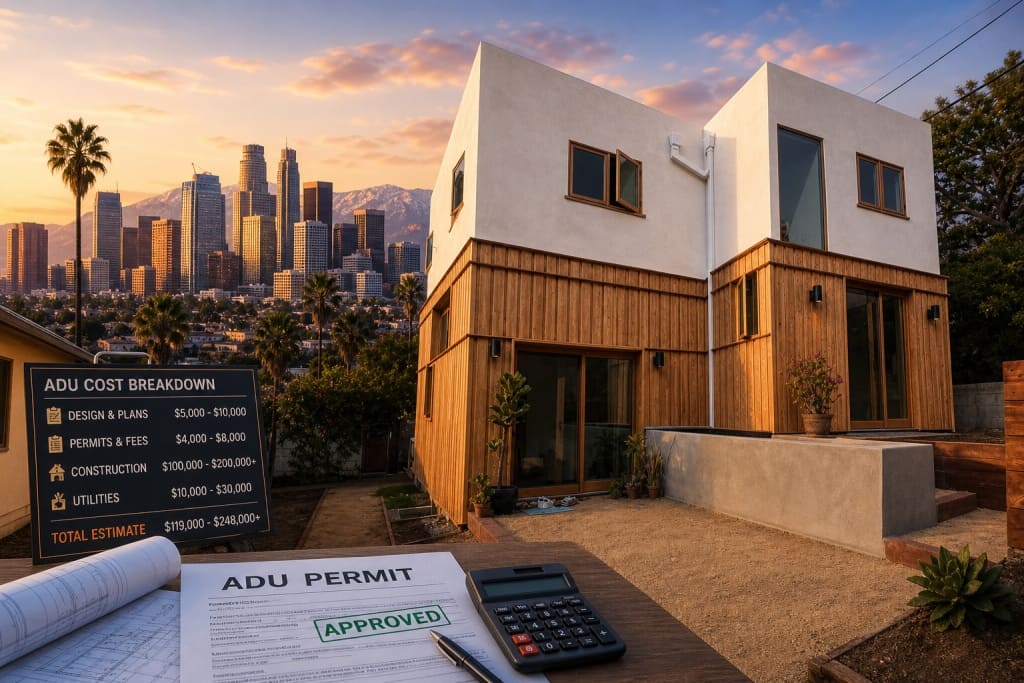
- Permits: Following Miami-Dade’s revised fee schedule (effective October 1, 2025, the first increase in 17+ years), total county fees for a small ADU typically run $1,500–$3,000
- Architect/engineering: 8–12% of construction cost, reflecting HVHZ structural requirements
- Utility connections: $3,000–$10,000 depending on distance from existing lines
Miami-Dade’s pre-approved ADU Blueprint program is worth exploring before commissioning custom architecture — these designs have already cleared structural and zoning review, shortening the permit timeline meaningfully.
Use the FindADUPros ADU Cost Calculator to build a project-specific budget and the ADU Loan Calculator to model financing.
HOA Rules: The Restriction County Zoning Can’t Override
This is the biggest hidden obstacle for a backyard cottage in Miami — and it has nothing to do with county zoning. If your property sits within an HOA, its governing documents may restrict or prohibit ADU construction regardless of what Miami-Dade allows. Florida law doesn’t strip HOAs of this authority. Many require architectural review approval and some maintain blanket prohibitions written into their CC&Rs.
Before spending anything on design, pull your recorded CC&Rs from the county clerk’s records and check specifically for language on “accessory structures” or “secondary dwelling units.” A county-approved permit provides no protection against an HOA violation — and in some cases an HOA can force removal of a structure the county fully approved.
Certificate of Use: The Ongoing Requirement
Unlike most jurisdictions, Miami-Dade requires an annual Certificate of Use renewal for every ADU regardless of rental status, including exterior inspections at renewal. Most notably, rentals require a minimum one-month lease term — effectively prohibiting Airbnb-style use. Only the owner can obtain a CU, and it’s non-transferable on sale. Occupancy is capped at two persons per bedroom, excluding children under three.
Timeline and Rental Return
A straightforward project runs four to eight months from application to Certificate of Occupancy, longer with correction letters or inspection backlogs. Rental income runs $1,500–$2,500/month depending on size and neighborhood. At $1,800/month, a $150,000 project generates $21,600 annually before expenses — roughly a 14% gross yield, settling to 6–9% net after taxes, insurance, and maintenance.
One planning note: renting an ADU requires a landlord policy covering the additional structure, loss-of-rental-income, and tenant liability — a standard homeowner’s policy won’t cover it, and windstorm/flood coverage carries particular weight in Miami-Dade.
The Bottom Line
Miami-Dade has built one of the more mature ADU frameworks in Florida — clear eligibility across 171,000+ lots, a pre-approved design library, and a state mandate pushing every jurisdiction toward permitting at least one unit per lot. The complexity comes from three sources: hurricane compliance with zero workaround, an owner-occupancy rule that catches absentee investors off guard, and HOA restrictions that can override county approval entirely.
Confirm zoning and HOA covenants before any design work. Budget for the HVHZ premium from day one. Factor the annual Certificate of Use renewal and one-month minimum lease into your rental strategy.
For vetted Miami-Dade contractors with verified HVHZ construction experience, visit FindADUPros.
Frequently Asked Questions
How much does an ADU permit cost in Miami?
Total Miami-Dade County permit fees for a small ADU typically run $1,500–$3,000 under the revised fee schedule effective October 2025. This excludes utility connections ($3,000–$10,000) and architect/engineering fees, typically 8–12% of construction cost due to hurricane compliance requirements.
Do I have to live on my property to build an ADU in Miami-Dade?
Yes. The owner must occupy either the primary residence or the ADU as a principal residence — you cannot rent both simultaneously while living elsewhere. If you live in the primary home, the ADU can be rented to anyone or used for any personal purpose.
Can my HOA stop me from building an ADU even if the county approves it?
Yes. Florida law doesn’t override private HOA covenants. If your community’s governing documents restrict accessory structures, that applies regardless of county zoning approval — always review your CC&Rs before starting design.
Why does building in Miami cost more than other cities?
Miami-Dade’s High-Velocity Hurricane Zone designation requires every ADU to meet 170–180 mph wind ratings, impact-resistant windows and doors, and engineered hurricane-resistant foundations. This adds roughly 15–25% to construction costs with no exceptions.
Can I use my Miami ADU as an Airbnb?
No. Miami-Dade’s Certificate of Use requirements restrict rentals to a minimum one-month lease term, effectively prohibiting short-term rental use, and require annual renewal with exterior inspections regardless of occupancy status.