
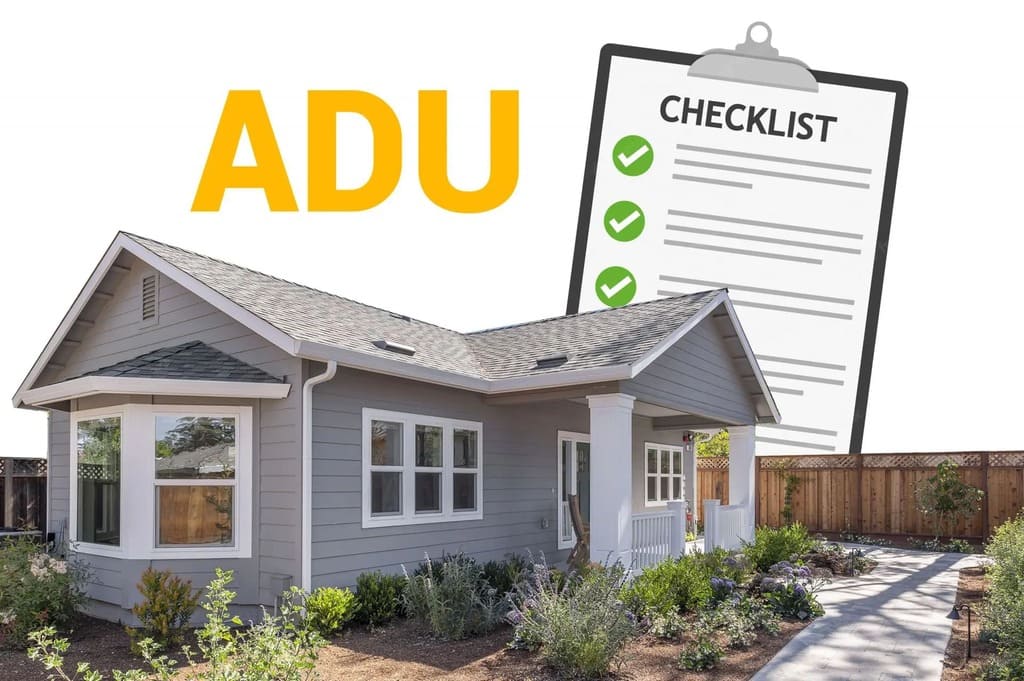
By the time most homeowners sit down to actually sign a construction contract, they’ve already spent weeks comparing bids, checking references, and picturing what the finished unit will look like. That excitement is exactly why this particular document deserves a slower, more skeptical read than any other part of the process. You’re not agreeing to a price anymore. You’re agreeing to a legal document that will govern every disagreement, delay, and surprise that comes up over the next several months, and a six-figure ADU build produces more of those than people expect.
A good ADU contractor contract checklist isn’t about distrusting your builder. It’s about making sure the agreement actually reflects the conversation you had with them, in writing, in specific enough language that there’s no room for a different interpretation later. This guide walks through exactly what an ADU contractor contract checklist should cover, what homeowners commonly miss, and which red flags mean you should put the pen down and ask more questions.
A sound ADU contract identifies the parties involved, a detailed and project-specific scope of work, a clear price structure, payment milestones tied to completed work rather than the calendar, realistic start and completion expectations, who’s responsible for permits, proof of insurance, warranty terms, a documented change-order process, a dispute-resolution procedure, and lien protections. If any one of those pieces is missing, vague, or left as a placeholder to “fill in later,” that’s a reason to pause before signing.
Why an ADU Contract Needs More Detail than a Standard Remodel Quote
Using an ADU contractor contract checklist matters more here than it would for a typical home project. A kitchen remodel touches one or two trades and rarely involves a separate permitting process. An accessory dwelling unit is closer to building a small house: it typically involves design, structural work, a full permit review, new or modified utility connections, multiple rounds of inspection, and coordination across framing, electrical, plumbing, and finish trades, often with several subcontractors working under one general contractor’s license.
That complexity is precisely why a generic one-page remodel quote isn’t sufficient for an ADU project. Every point where trades hand off to each other, where inspections happen, or where a permit condition could change the scope, is a place where an ambiguous contract creates room for disagreement later. An ADU contractor contract checklist exists specifically to catch those gaps before they become expensive arguments mid-project.

The 15-Point ADU Contract Checklist
Every one of these items should appear in writing, with project-specific details rather than generic boilerplate language.
- Contractor legal name, license number, and business address. This should match exactly what comes back when you run the license through your state’s verification system, not just a “doing business as” name on a business card.
- Complete scope of work and attached plans or specifications. The contract should reference the actual approved plan set by date and revision number, not a general description like “build ADU per plans.”
- Allowances, exclusions, and owner-supplied materials. If fixtures, appliances, or flooring are budgeted as an allowance, the dollar amount and what happens if you exceed it should be spelled out.
- Fixed price versus cost-plus pricing and contingencies. You should know exactly which pricing model you’re agreeing to, and what percentage contingency, if any, applies to cost-plus arrangements.
- Payment milestones tied to completed work. Draws should correspond to verifiable construction stages, foundation poured, framing complete, rough-in inspection passed, not arbitrary calendar dates.
- Permit responsibility and fees. The contract should state clearly whether the contractor or the homeowner pulls permits and who absorbs permit fee increases if plans change.
- Start date, substantial completion date, and delay rules. Look for language addressing what counts as an excusable delay versus a contractor-caused one.
- Change-order procedure. Every legitimate contract requires changes to be documented in writing, priced, and signed by both parties before work proceeds.
- Insurance and workers’ compensation proof. General liability and workers’ comp certificates should be attached or referenced by policy number, not just promised verbally.
- 10. Subcontractor responsibility. The contract should state that the general contractor remains responsible for subcontractor work quality and scheduling.
- Inspection responsibilities. Clarify who schedules required inspections and who’s responsible if a failed inspection causes delay.
- Warranty language. Look for a specific warranty period and what it covers, materials, workmanship, or both, separate from manufacturer warranties on appliances and fixtures.
- Lien releases. The contract should require conditional and unconditional lien waivers from the contractor and subcontractors at each payment stage.
- Termination and default terms. Both parties should know what happens, and what’s owed, if either side wants to exit the agreement.
- Dispute-resolution and governing-law provisions. Mediation or arbitration clauses aren’t automatically bad, but you should know what you’re agreeing to and whether it waives your right to sue in court.
Running through this ADU contractor contract checklist line by line before you sign takes maybe twenty minutes, and it’s twenty minutes that can save months of frustration if a disagreement surfaces later.
Must-Have, Ask About, Walk Away: A Quick Reference
| Must-Have (non-negotiable) | Ask About (get clarity in writing) | Walk Away (serious red flag) |
| Contractor’s license number matching state records | How allowance overages are billed | Blank price or scope fields at signing |
| Detailed, plan-referenced scope of work | Who handles permit fee increases | Requests for more than 10–15% upfront |
| Payment milestones tied to inspections or stages | Estimated timeline for change-order approval | No written payment schedule at all |
| Proof of general liability and workers’ comp insurance | Whether subcontractors are pre-approved or TBD | Refusal to name subcontractors before starting |
| Written change-order process | What triggers a “delay” versus a “default” | Verbal promises not reflected anywhere in writing |
| Lien waiver requirements at each draw | How disputes are resolved and where | Pressure to sign the same day with no review time |

Clauses Homeowners Commonly Overlook
A few provisions tend to slip past even careful readers, mostly because they sound minor until they matter.
- Allowance overages. It’s common for a contract to include an allowance for something like lighting fixtures or flooring, but far less common for the contract to clearly state what happens if the homeowner’s selections exceed that allowance. Without a clause addressing this, you may end up in an informal negotiation mid-project instead of a pre-agreed process.
- Escalation clauses. Given how material prices can shift, some contracts include a clause allowing the contractor to pass through price increases on specific materials; lumber or copper wiring are common examples, beyond a certain threshold. This isn’t necessarily unreasonable, but it should be capped and clearly defined, not open-ended.
- Concealed-condition clauses. ADU builds, especially conversions or additions tied to an existing structure, sometimes uncover conditions that weren’t visible during bidding, old plumbing, unpermitted prior work, or soil issues. A contract should specify how these discoveries are priced and approved rather than leaving it as an open-ended change order.
- Access and site-damage rules. Who’s responsible for repairing landscaping, irrigation, or fencing disturbed during construction should be addressed directly, since this is a frequent source of post-project disputes.
- Cleanup and debris removal. It sounds minor, but ongoing job-site cleanup and final debris haul-away should be explicitly assigned, since disputes over a messy site dragging into the final walkthrough are more common than you’d expect.
Contract Red Flags That Justify Stopping Before You Sign
Some issues are serious enough that they should stop the signing process entirely until resolved:
- Blank spaces left in the price, scope, or date fields, with a promise to “fill it in later.”
- Verbal promises or add-ons that were discussed but never made it into the written contract.
- Vague labor descriptions like “as needed” or “TBD” in place of a defined scope.
- A payment schedule that’s unusually front-loaded, for example, a large deposit before any material has been delivered or work has started.
- No written payment schedule at all, just a total price and a handshake understanding of when money changes hands.
If you spot any of these while going through your ADU contractor contract checklist, it’s worth pausing the signing process until the contractor addresses it in writing.
Ten Questions to Ask Before You Sign
- Can you walk me through exactly how each payment milestone will be verified?
- What happens if my project requires a change order? How quickly will I get a price?
- Who are the subcontractors you plan to use, and are they licensed and insured?
- What’s your process if an inspector requires rework?
- How do you handle unexpected conditions found once work begins?
- What’s included in your warranty, and for how long?
- Who is responsible for pulling and paying for permits?
- What happens if the project runs past the substantial completion date?
- Can I get lien waivers at each payment stage, not just at the end?
- Is there a cap on any material escalation clause in this contract?
A contractor who answers these clearly and without hesitation is generally a good sign. A contractor who gets defensive or vague about any of them deserves a closer look before you move forward.

Before-You-Sign Action List
Before putting a signature on anything, run through this short list:
- Verify the license independently. Don’t rely on what’s printed on the contract. Confirm it directly using FindADUPros’ contractor license lookup tool to check standing, bonding, and any complaint history.
- Request and review insurance certificates. Call the insurance provider listed if anything looks off, most legitimate contractors won’t mind.
- Call at least two references from completed ADU projects, not just any construction project, since ADU-specific experience matters given the permitting complexity involved.
- Reconcile the contract against the original bid. Make sure the final scope, price, and allowances match what you were quoted, not a scaled-down version with the same total price.
- Confirm your numbers still work. Run the finalized contract price through FindADUPros’ ADU cost calculator and, if financing is involved, FindADUPros’ ADU loan calculator, so there are no surprises once the first draw is due.
- Double-check zoning and design assumptions. If anything in the contract references unit size, setbacks, or design specifics, confirm those against FindADUPros’ zoning information lookup tool and, if you’re still refining the plan, FindADUPros’ AI ADU design advisor.
- Consider a local attorney review for larger contracts. For a project of this size, a one-time consultation with a construction attorney is a relatively small expense against the total project cost, particularly if any clause feels unclear.
The Bottom Line
An ADU contractor contract checklist isn’t about assuming the worst of your builder; it’s about making sure a good working relationship stays good once real money and real deadlines are on the table. The contract should read like a project-specific document built around your plans, your price, and your timeline, not a generic template with the blanks barely filled in. Take the extra day to read it carefully, verify what you can independently, and ask direct questions about anything that feels vague. If you’re still comparing contractors or want help finding vetted, licensed professionals in your area, FindADUPros can help match you with contractors who are used to producing exactly the kind of clear, detailed agreement this checklist describes.